


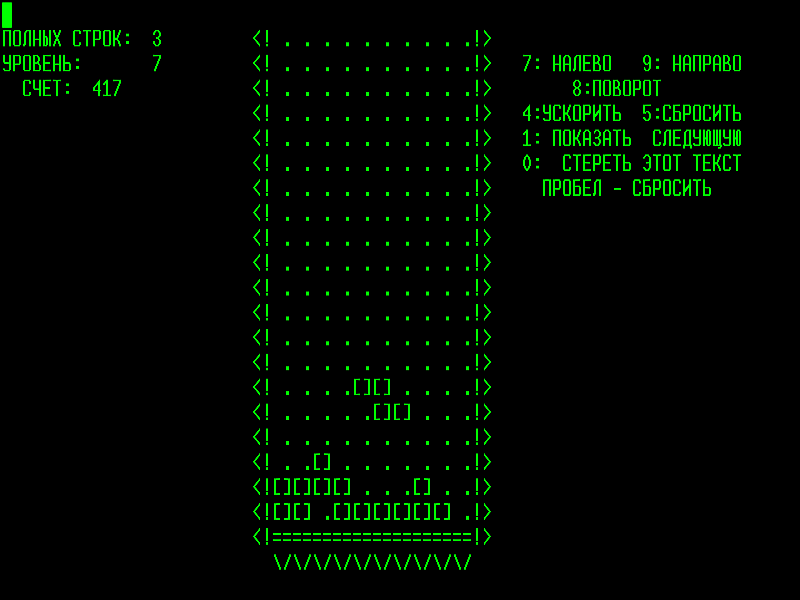
“Holding” pieces in Tetris is a later development1: it was not a feature in the original Tetris for PC, Game Boy or SNES. Today’s players would perhaps be asea without the feature, but its addition was not without controversy2, and there’s still a strong championship scene around NES Tetris whose competitors soldier on without a hold queue.3
“Holds” are very powerful – perhaps even too powerful. Rather than react nimbly to an ill-timed piece which might have to be built into a new line of garbage, one can dump it into the holding area as an unwanted inconvenience. Of course, one can also catch and hold in reserve an especially valuable piece in order to deploy it at the most opportune time for a big boost in score.
So holding is potent; but it also makes for great fun. I’m not advocating for the mechanic’s removal, but I think there might be an interesting way to restore some of the game balance it destabilizes. I’m imagining a version of Tetris that makes “holds” a limited resource which the player must employ strategically. This limited number of holds would be agreed upon by all players during game setup: none (the “classic” mode), one, three, five, seven, or unlimited (as in today’s Tetris, which should remain an option for those who have only ever known that style).
I’d vibe-code all this to see how it’d play; but there are Tetris copyrights and trademarks involved. I’m enough of an artist – and enough of a gamer – to want to see IP respected.
Alexey Pajitnov programmed Tetris in 1984, but the hold queue was not introduced until 15 years later in the N64 title, The New Tetris. Even there, the game’s Initial Hold System is not what “guideline games” use today.
“The inclusion of the hold mechanic in standard Tetris has been controversial, with some critics arguing that it makes the game too easy.” Hard Drop contributors, “Hold piece,” Hard Drop Tetris Wiki, accessed November 7, 2026.
Massachusetts Institute of Technology, “MIT’s Justin Yu Wins Classic Tetris World Championship,” MIT EECS, accessed November 4, 2026.
Nice use of “asea.”