


I was once known as “the iconmaster.”1 The appellation has been often misunderstood. Circa 1996, I became interested in the little images that stand in for computer programs on desktop computers.
Xerox started it. Though best known for its copy machines, then-president Charles Peter McColough established the Xerox Palo Alto Research Center in 1970. I have never really been sure why Xerox took this step. It seems likely that its executives became apprehensive that the era of paper-bound office work was ending, which could only mean trouble for a business built on printing. Better to get ahead of this “computing” thing before it made Xerox obsolete.
Xerox PARC produced an astonishing number of inventions that would come to dominate computing for half a century: electronic paper, object-oriented programming, personal computing, the “desktop” computing metaphor, and the mouse input device required to drive it.
In 1979, Apple Computer’s Steve Jobs made an arrangement with Xerox to allow Apple engineers access to Xerox’ research. Famously, Jobs has said “They just had no idea what they had.” It was Apple, under Jobs, who went on to commercialize the personal computer with the Macintosh in 1984. The era of the graphical user interface had begun. (Microsoft would follow quickly with Windows 1.0 in 1985.)
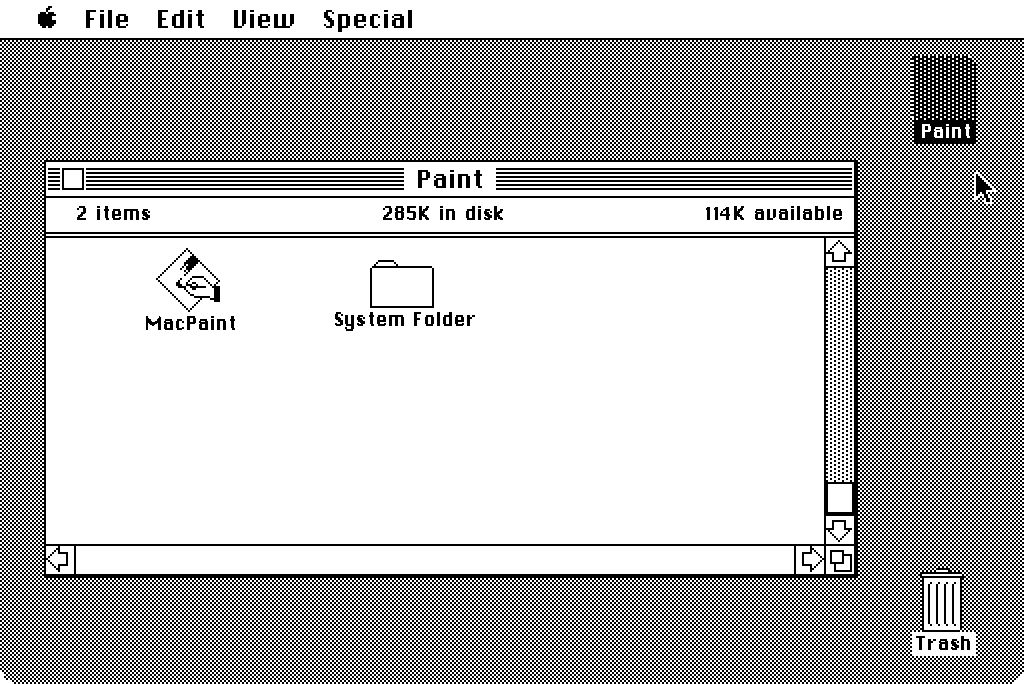
Besides Jobs, a number of key figures made the early Apple what it was. There was Bruce “Tog” Tognazzini, employee #66, who “designed Apple’s first human interface and wrote eight editions of the Apple Human Interface Guidelines.”2 Today, “Tog” is a principal at the Nielsen Norman Group, a research and UX design firm.
Bill Atkinson, employee #51, created the MacPaint and HyperCard applications. While Atkinson was (somewhat famously) a microdoser of psychedelics, it was pancreatic cancer that ended his life at age 74 in 2025.
MacPaint owes its existence to another key contributor: Susan Kare.
The lower case is intended.