


In Part 1, with reckless historiography, I traced the early development of the graphical user interface from its nascency at Xerox PARC through to its flowering at Apple Computer.
I previously passed over Xerox PARC much too quickly, as it employed several figures – as predecessors to Susan Kare, I think of them as “the pre-Karatics”1 – who were key to the history of icon design. Xerox was already experimenting with a graphical user interface on its 1973 Alto machine; but while the Alto offered a windowing system and file and folder icons, it did not really incorporate application icons as we understand them today. The Alto’s Smalltalk environment featured a graphical representation of a mailbox that indicated whether mail packets were available on disk, but it did not double as a mechanism to open an electronic mail2 application. To access one’s mail, one needed to switch out of Smalltalk into the “Laurel” mail application.
The first pre-Karatic, David Canfield Smith, Ph.D., would join Xerox in 1976. During his postgraduate years at Stanford University, Smith had become interested in the idea of visual programming – a user communicating to the computer “program intent” via drawn diagrams. This seminal notion engendered twin fruits: the Pygmalion programming system, and its parallel doctoral thesis bearing the same name.
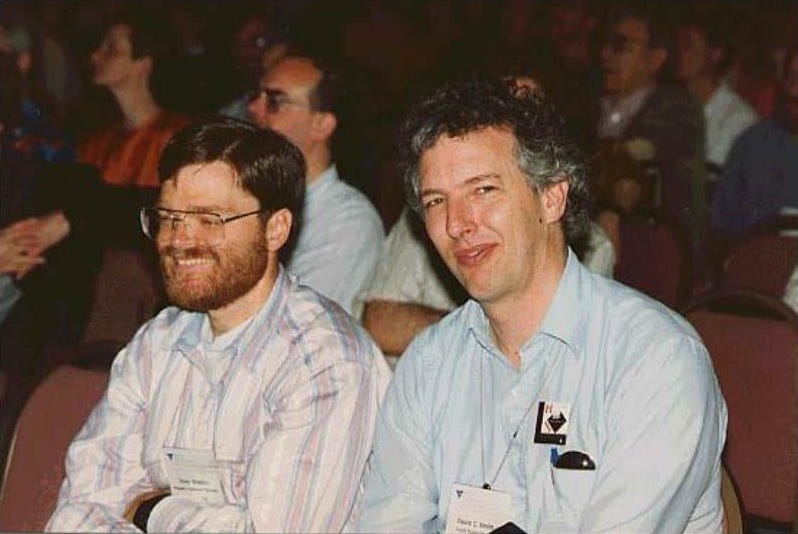
Pygmalion the programming system represented an analogical, metaphorical approach to programming. As Smith writes3:
structures and actions in a context using analogical representations (a “metaphorical” context) have a functional similarity to structures and actions in the context being modeled. One can discover relationships in a metaphorical context that are valid in the other context.
The associated paper’s abstract4 is enough to make any icon designer’s heart sing. It promises that Pygmalion is:
a two-dimensional, visual programming system implemented on an interactive computer with graphics display. It is both a programming language and an environment for experimenting with ideas. Communication between human being and computer is by means of visual entities called “icons”, subsuming the notions of “variable”, “reference”, “data structure”, “function” and “picture”. The heart of the system is an interactive “remembering” editor for icons, which executes and (optionally) saves operations for later re-execution.
Why did David Canfield Smith decide visual entities representing operations should be called “icons”? Fascinatingly, he saw a close parallel between what he was attempting with Pygmalion and what religious artists try to accomplish with their works: embodying ineffable qualities in a concrete representation.5
The computer icon in its very origin is, at least analogically, a religious construct.
Xerox designer Norman Cox identifies6 Bill Bowman, Wallace Judd, David Canfield Smith, and himself as creators of the early icon designs for the Star. Cox’s account divides the early work into two groups: Bowman and Judd, followed by Smith and himself. Their effective period of collaboration spanned roughly the years from 1978 through 1982.

Bill Bowman’s life story is worth reading in its entirety.7 As a member of the Holy See light show troupe, Bowman worked on shows for Jimi Hendrix, Led Zeppelin, the Grateful Dead, The Who, and many more. This will come up again: a later icon artist would also discover light shows as a novel avenue for his artistic talent.
Norm Cox may be the designer who first dog-eared paper in an icon, providing us with a clue to the desktop metaphor that has been carried down to this day. However, he did not invent the dog-ear convention but took his inspiration from a graphical element near at hand:
The turned-down corner inspiration came from an icon embossed on the office copier that instructed users how to correctly insert documents into the feeder–face up or face down.8
You’ve probably seen such an embossed dog-ear on a copier or printer yourself. Tracking down the real inventor of the convention would make for an engrossing line of research, but it might require visiting the Xerox Historical Archives on the former Xerox campus at Webster, New York.
Now, we can at last turn our attention to Susan Kare in Part 3.
After the “pre-Socratics,” of course. It’s amusing to me to think that Pythagoras had no notion that he was “pre-Socratic”; no one would know that until the late 18th century.
“Email,” yes, but that shorthand came later.
David Canfield Smith, “Pygmalion: An Executable Electronic Blackboard,” in Watch What I Do: Programming by Demonstration, edited by Allen Cypher, MIT Press, 1993.
David Canfield Smith, Pygmalion: A Computer Program to Model and Stimulate Creative Thought, Birkhäuser, 1977.
Wikipedia contributors, “The development of icons,” Wikipedia, accessed October 30, 2026.
Norman Cox, “The (Xerox Star Icon) World According to Norm Cox,” DigiBarn Computer Museum, n.d.
Robert Doerschuk and Linnea Bowman, “Celebrating Bill Bowman,” Substack, July 13, 2026.
Benj Edwards, “The Computer Folder Is 40: How the Xerox Star Created the Desktop,” How-To Geek, December 21, 2021.
99% of this is above my paygrade, but I approve of the title! I didn't realize the choice of "icon" as a name was so intentional.